
Secure Protocols for AI Agents: Beyond MCP
Explore how next-gen protocols enable secure, structured AI agent communication—beyond MCP.

TL;DR:
MCP gave AI models a simple way to use tools, just like a library card for checking out books. But when agents need to securely and clearly communicate, they need something more.
They need a reliable postal service.
That’s what next-gen protocols could do: they wrap messages in secure, structured envelopes so every agent knows exactly what’s happening.
Imagine this…
You’re responding to emails while riding a train. After a delay, your AI travel agent is rebooking your flight. To reschedule meetings, your calendar agent works with the assistants of your peers. Your budgeting bot verifies that the new ticket complies with corporate guidelines.
You didn’t touch a thing. Each agent just… talked. Securely. Seamlessly. With purpose.
This isn’t science fiction—it’s what the next communication protocols could make possible. If MCP gave your AI a library card, the next gen protocols give it a postal service: signed, structured, reliable messages for agents to work together, not just alone.
1. What is MCP? Library Cards for AI
Assume that you issued your AI model with a library card. The AI can rapidly query databases, search engines, and even bespoke services with MCP (Model Context Protocol). MCP obviates the need for clunky bespoke code by defining the way AI makes these types of calls uniformly.
But there's a catch: MCP is ideal for one-off solitary things. As soon as you need several agents working together, with trust, purpose, and context shared, it is difficult
Summary: MCP reduces single-agent jobs but is not effective with agent-to-agent communication
2. Why MCP Falls Short for Multi-Agent Communication
Here’s where MCP hits limits:
Intent Confusion: MCP doesn’t clearly say what an agent’s action means (like “summarize” or “translate”). Each developer must guess what these actions represent.
Messy Context Sharing: Every time one agent wants to share context, it sends the entire conversation history again, wasting resources.
Security as an Afterthought: MCP doesn’t have built-in security. It’s like passing notes without envelopes, hoping nobody else reads them.
No Built-In Streaming: MCP doesn’t clearly handle streaming data piece-by-piece. You have to manually handle incomplete messages and ordering.
MCP lacks built-in clarity, trust, and efficiency for agent-to-agent talk.
3. Aren’t Agent Orchestrators Enough?
Agent workflows are organized with the aid of tools like HuggingGPT, CrewAI, and LangGraph, which manage activities and keep track of previous actions. However, orchestrators are not messengers; they are administrators. They don’t specify how agents should trust one another or communicate clearly. Messages are still transmitted in JSON format, which lacks any inherent meaning or validation, and is generally heavy.
In summary, work is coordinated by orchestrators, and trustworthy and transparent communication is defined by protocols.
4. A Secure Messaging Protocol for AI
Think of the next-gen protocols as sending letters securely through the mail.
Here’s what a simplified message might look like:
{
  "header": {
    "sender":    "Agent Alice",
    "receiver":  "Agent Bob",
    "time":      "2025-06-10T12:00:00Z",
    "signature": "cryptographic-stamp" // e.g., Ed25519 or COSE
  },

  "body": {
    "intent":      "Summarize",
    "context":     "Summary request from user.",
    "content":     "The article explains next-gen protocols...",
    "chunk":       1,
    "more_chunks": false
  }
}
Each message would clearly show:
Who sent it (sender)
Who it’s for (receiver)
What it’s about (intent)
Why it was sent (context)
What’s inside (content)
Whether more is coming (chunk / more_chunks)
🔐 In real systems, each message is signed using Ed25519 or COSE to ensure authenticity and prevent tampering.
An advanced protocol provides clear structure, security, and meaning to every agent interaction.
5. Next Gen Protocols vs. MCP
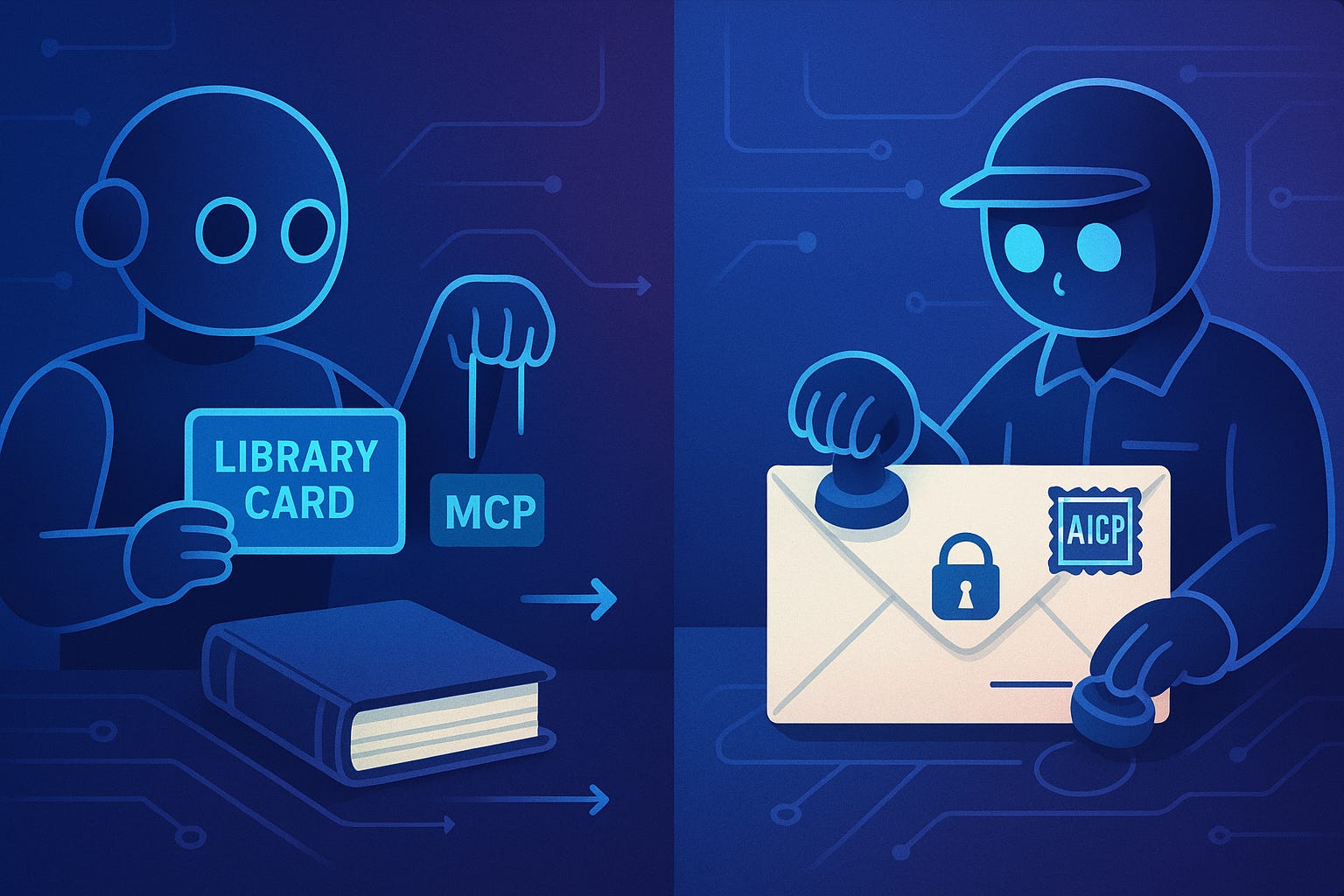
Currently (MCP / Library Card): Borrow a book easily but must manually copy pages and hand them around.
Later (Next-Gen Protocols / Postal Service): Send clearly labeled, sealed letters directly to the right agent—no confusion or copying by hand.
6. Why Better Protocols Matter for AI App Users
So how does this techy stuff actually affect real people?
Your AI won’t forget things between tabs. Agents can securely hand off your intent—like “book the flight” or “reschedule my meeting”—without copying your calendar or profile every time.
AI apps can collaborate like coworkers. Instead of siloed bots, you get assistants that talk, negotiate, and divide tasks behind the scenes—with proof of who said what.
Fewer bugs. More trust. When apps speak a common language with signed messages, there’s less guessing, less “what did it mean by ‘summarize’?”, and fewer errors that cost time (or privacy).
A platform shift. Think of how the web evolved: FTP gave way to HTTP, then HTTPS. Next-gen protocols are that jump—but for autonomous agents.
7. Why Developers Need Next-Gen Protocols
Ad-hoc JSON fatigue: Teams still invent custom JSON schemas for every agent call—duplicated parsing, inconsistent fields, brittle integrations.
Boilerplate security: Channel-level TLS/OAuth is great, but per-message integrity and non-repudiation often fall to bespoke code.
Context bloat: Agents burn bandwidth and CPU without a compact proof mechanism (Merkle roots, for example) by resending full histories on every cal,
DIY chunking: Large payloads force developers to layer custom fragmentation on HTTP or WebSocket streams which is error-prone and nonstandard.
Next-generation protocols allow teams to concentrate on core logic instead of security and interoperability by standardizing envelope schemas, signature, chunking, and purpose semantics.
8. Who Is Examining These Concepts Already?
Google Agent2Agent (A2A), a recently announced enterprise agent communication system that is structured and safe.
IBM ACP & BeeAI: Integrated message signing, orchestration, and discovery, open-sourced under the Linux Foundation.
Multi-agent frameworks that rely on customized JSON/RPC are ready for a uniform protocol, such as CrewAI, AutoGen, and LangChain.
W3C Agent Protocol: Establishing open, web-based standards for agent-to-agent communication.
9. What Advancements Could the Next Gen Protocols Integrate
Binary Formats: Smaller, faster envelopes (Protobuf/CBOR).
Merkle Proofs: Tiny fingerprints proving context without sharing the whole history.
Session Keys & HMAC: Quick, secure exchanges without expensive cryptography each time.
Capability Tokens (Macaroons): Precisely controlled access for agents, easy to revoke or adjust.

Challenge:
In the comments, draft a quick protocol envelope for a “Translate” action—define its header, body, and signature fields!
FAQs
Q: Do I need blockchain for advanced protocols?
A: No. Blockchain is optional, only if you need extra tamper-proofing.
Q: Isn’t OAuth enough security?
A: OAuth protects communication channels, not individual messages. Advanced protocols secure each message itself.
Q: Can I start simple (with JSON)?
A: Yes! You can upgrade to faster formats later.
Coming Soon:
"Why AI Agents Need Their Own Internet Protocol"
"From LangChain to CrewAI: Orchestrating Multi-Agent Systems"
"The Future of Autonomous Agents: Secure, Shared Intent"
Mini Challenge:
Reach out to me with ideas on a “live message walkthrough with Protobuf and QUIC.”
Subscribe, like and share your questions below! While it is free for you, it supports creators massively.
Ps. Found an error in this publication? DM or drop comment to ensure readers get accurate information. Thanks!